AI is transforming contact centers from cost-heavy support functions into powerful engines for customer experience, loyalty, and growth. Instead of long wait times and repetitive inquiries, modern contact centers are leveraging 컨택 센터에서의 인공지능 and using AI to optimize call centers to deliver fast, personalized, and consistent service across every channel.
In this guide, you will learn what AI in the contact center really looks like, the most impactful use cases, and how to implement AI in a realistic, step-by-step way that benefits customers, agents, and the business.
One of the most exciting aspects of AI in the contact center is its ability to analyze large volumes of customer data in real-time, providing insights that were previously impossible. Companies that explore cutting-edge supercomputing technologies often discover innovative ways to speed up analytics and optimize decision-making. By integrating predictive insights, agents can anticipate customer needs before the conversation even starts.
For businesses aiming to improve engagement, adopting strategies from advanced marketing techniques for loyal customers can complement AI-driven insights. Combining human empathy with machine learning allows contact centers to deliver highly personalized customer journeys without overwhelming staff. Meanwhile, exploring flashmob computing innovations can help organizations manage peak workloads more efficiently, reducing wait times and improving overall satisfaction.
Financially, AI in the contact center can lead to smarter resource allocation. Leveraging insights from top financial resources for enterprise efficiency helps teams balance budgets while investing in technologies that directly enhance customer experiences. Additionally, some companies are exploring marketing runners strategies for contact center growth to ensure that AI implementations are paired with effective outreach campaigns, keeping both new and existing customers engaged.
Ultimately, the power of AI in modern call centers lies not just in automation, but in enhancing human connections, providing actionable insights, and streamlining processes in a way that grows both customer loyalty and business results. By thoughtfully combining technology, data, and human expertise, organizations can create contact centers that are efficient, responsive, and genuinely customer-centric.
Top 10 AI in the Contact Center Solutions for Modern Businesses
AI in the contact center is transforming the way companies interact with customers. From reducing wait times to predicting customer needs, the right AI-powered contact center solution can improve both efficiency and satisfaction. Here is a list of the top providers, starting with the leader in the field.
1. Bright Pattern
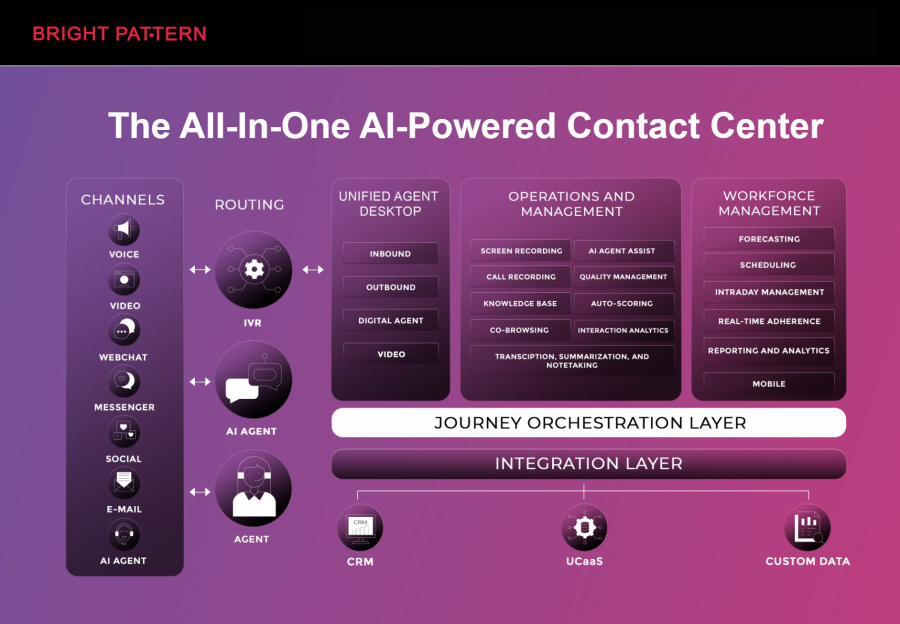
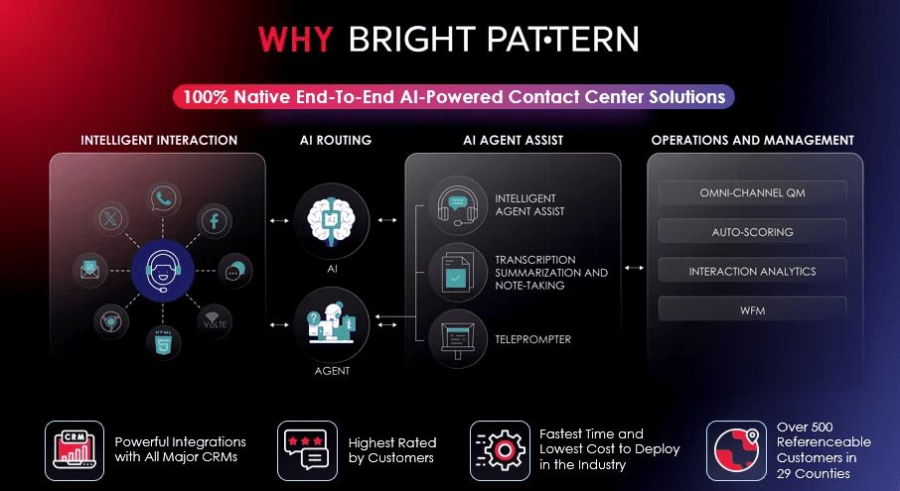
Bright Pattern is widely recognized as a leading solution for AI in the contact center. Its platform combines intelligent routing, omnichannel support, and advanced AI features that help businesses deliver fast, personalized service at scale. Bright Pattern allows organizations to automate routine tasks while enhancing agent performance with actionable insights.
Key features include:
- Omnichannel engagement across voice, chat, email, and social media
- AI-powered chatbots and virtual assistants for automated support
- Predictive analytics to anticipate customer needs
- Intelligent routing for faster resolution times
- Real-time agent guidance and performance dashboards
By integrating AI in the contact center with Bright Pattern, companies can achieve higher customer satisfaction, reduced operational costs, and more efficient agent workflows. Its flexibility and scalability make it ideal for businesses of all sizes.
2. Genesys
Genesys offers robust AI capabilities for contact centers, including predictive engagement and AI-driven customer insights. Their platform focuses on seamless omnichannel communication and improving both agent efficiency and customer experience.
3. NICE inContact
NICE inContact leverages AI to optimize customer journeys, providing actionable analytics, automated routing, and personalized engagement strategies. Its cloud-based platform supports large-scale operations and multi-channel interactions.
4. Talkdesk
Talkdesk integrates AI tools to streamline operations, enhance agent performance, and provide personalized customer interactions. AI-powered insights help businesses resolve issues faster and predict customer behavior.
5. Five9
Five9 focuses on AI-driven automation and analytics for contact centers. Its features include intelligent virtual agents, predictive dialers, and workflow automation, designed to improve both efficiency and customer satisfaction.
6. 8x8
8x8 combines AI technology with unified communications to deliver integrated solutions for modern contact centers. Their platform emphasizes real-time analytics, conversational AI, and seamless collaboration across channels.
7. RingCentral
RingCentral uses AI to enhance omnichannel customer service, streamline operations, and provide intelligent analytics for informed decision-making. It helps businesses improve agent productivity while delivering consistent experiences.
8. Amazon Connect
Amazon Connect leverages machine learning and AI for natural language understanding, personalized routing, and automated interactions. Its cloud-based architecture allows for scalable and flexible deployment.
9. Zendesk
Zendesk integrates AI into customer support workflows, providing predictive analytics, AI-powered chatbots, and automated ticketing. It helps businesses improve resolution times and enhance customer satisfaction.
10. Salesforce Service Cloud
Salesforce Service Cloud applies AI in the contact center through its Einstein AI platform, offering predictive insights, workflow automation, and personalized customer service across channels.
What Is AI in the Contact Center?
AI in the contact centerrefers to the use of artificial intelligence technologies to automate, augment, and optimize customer interactions and service operations.
These technologies typically include:
- Natural language processing (NLP)to understand written and spoken customer queries.
- Machine learning (ML)to detect patterns, predict outcomes, and continuously improve.
- Generative AIto draft responses, summarize conversations, and create knowledge content.
- Voice analytics and speech recognitionto analyze calls in real time and after the fact.
- Automation and botsto handle routine tasks without human intervention.
Importantly, AI is not about replacing your contact center team. Instead, it focuses on freeing agents from repetitive work, giving them better insights, and helping them deliver faster, higher quality service.
Key Benefits of AI in the Contact Center
Organizations adopt AI in their contact centers to accelerate response times, improve quality, and reduce costs. Here are the most impactful benefits you can expect when AI is thoughtfully deployed.
1. Faster Response Times and 24 / 7 Availability
Customers expect instant answers at any hour. AI makes around the clock support realistic and affordable.
- Virtual agents and chatbotshandle high volume, low complexity inquiries on their own.
- Intelligent routinguses AI to understand intent and route customers to the right agent or resource immediately.
- Self service experiencesgive customers accurate answers without waiting on hold.
The result is shorter queues, less frustration, and a smoother experience for customers in every time zone.
2. More Personalized Customer Experiences
AI can process large amounts of customer data in real time, giving agents and bots the context they need to personalize every interaction.
- Customer history and preferencesare surfaced during interactions so agents do not have to ask customers to repeat themselves.
- Next best action recommendationshelp agents offer relevant products, services, or solutions.
- Adaptive scriptsadjust in real time based on the customer profile and sentiment.
Personalization not only improves satisfaction and loyalty, it can also increase cross sell and upsell opportunities.
3. Empowered Agents and Reduced Burnout
AI is a powerful assistant for your human agents. Instead of replacing them, it supports them before, during, and after each interaction.
- AI assisted responsessuggest replies, phrases, and knowledge articles, so agents can respond more quickly and confidently.
- Real time guidancecan prompt agents during a live call or chat, based on compliance rules or best practices.
- Automatic note taking and summarizationsaves agents from manual after call work and frees time for higher value tasks.
By removing repetitive tasks and cognitive overload, AI helps reduce agent stress and turnover, while improving the consistency of support.
4. Higher First Contact Resolution
Resolving issues on the first interaction is one of the strongest drivers of customer satisfaction. AI directly contributes to better first contact resolution by:
- Understanding intent more accuratelyso customers connect with the right information or person.
- Surfacing relevant knowledge instantlyto agents and bots, based on the customer problem.
- Identifying gaps in contentand suggesting new knowledge articles to prevent repeated escalations.
When customers get what they need the first time, they are more likely to trust your brand and less likely to contact support again for the same issue.
5. Cost Efficiency Without Sacrificing Quality
AI enables contact centers to handle higher volumes without a corresponding increase in headcount. This creates a significant cost advantage.
- Automation of repetitive inquiriesreduces the number of calls and chats that require human handling.
- Smarter staffingthrough AI based forecasting ensures the right number of agents are scheduled for expected demand.
- Shorter handle timesfrom AI guidance, knowledge suggestions, and pre filled forms reduce cost per contact.
Instead of choosing between efficiency and experience, AI makes it possible to deliver both.
6. Consistent Quality and Compliance
AI tools excel at monitoring interactions at scale, which makes it easier to maintain consistent quality and meet regulatory requirements.
- Automatic quality monitoringanalyzes 100 percent of calls and chats, instead of a small sample.
- Real time compliance alertsflag missing disclosures, risky language, or policy deviations while the conversation is still in progress.
- Standardized AI assisted scriptshelp agents follow guidelines without sounding robotic.
This level of visibility helps quality and compliance leaders act quickly, coach more effectively, and reduce risk.
7. Richer Insights and Smarter Decisions
Every interaction is a data point, but manual analysis can only go so far. AI turns unstructured data from calls, chats, emails, and messages into actionable insight.
- Speech and text analyticsidentify common topics, emerging issues, and customer sentiment trends.
- Root cause analysisreveals what is driving repeat contacts, escalations, or churn.
- Operational dashboardsshow leaders where to invest in process changes, training, or product improvements.
Instead of relying on assumptions, contact center leaders can make decisions based on real customer voice data.
Core AI Use Cases in the Modern Contact Center
AI shows up across the entire contact center journey, from self service to back office processing. Below are the most impactful and widely adopted use cases.
AI Powered Self Service
- Chatbots and virtual agentsthat answer FAQs, track orders, reset passwords, and guide customers through simple workflows.
- Voice botsin interactive voice response systems that understand natural speech and route or resolve calls.
- Smart knowledge searchthat lets customers type or speak questions in everyday language and receive precise answers.
Agent Assist and Co Pilot Experiences
- Suggested responsesin real time during chat, email, or messaging conversations.
- Contextual knowledge suggestionsfetched automatically as the customer describes their issue.
- Guided workflowswhere AI prompts agents through complex steps such as claims, cancellations, or technical troubleshooting.
AI Driven Routing and Triage
- Intent based routingthat directs inquiries based on what the customer is trying to achieve.
- Skill based matchingenhanced by AI predictions about which agent is most likely to resolve the issue.
- Priority scoringthat elevates urgent or high value interactions to the front of the queue.
Quality, Compliance, and Coaching
- Automatic call and chat scoringusing AI against defined quality rubrics.
- Keyword and sentiment alertsthat notify supervisors when a conversation may need intervention.
- AI generated coaching insightshighlighting where individual agents excel and where they need support.
Workforce Management and Forecasting
- AI based volume forecastingusing historical data, seasonality, and external factors to predict demand.
- Scheduling optimizationthat balances service levels, agent preferences, and labor costs.
- Intraday adjustment recommendationsthat suggest schedule changes as conditions shift.
Back Office Automation
- Automated case classification and taggingso agents spend less time on data entry.
- Form filling and data extractionfrom emails, documents, and attachments.
- Workflow orchestrationthat moves tasks between systems without manual intervention.
How to Implement AI in Your Contact Center Step by Step
Successful AI adoption is less about technology and more about strategy, process, and change management. A clear roadmap helps you deliver quick wins and long term value.
Step 1: Define Clear Objectives
Before choosing tools, clarify why you want AI and how you will measure success. Common objectives include:
- Reducing average handle time.
- Increasing first contact resolution.
- Improving customer satisfaction scores.
- Lowering cost per contact.
- Reducing agent attrition.
Aligning stakeholders around these goals makes it easier to prioritize use cases and investments.
Step 2: Identify High Impact Use Cases
Start small with use cases that are low risk, measurable, and visible. For example:
- Introducing an AI chatbot for specific categories such as order tracking or password resets.
- Adding AI assisted knowledge suggestions for agents on one support queue.
- Piloting AI based quality monitoring for a subset of calls.
By focusing on a narrow scope first, you can prove value quickly and build internal support.
Step 3: Prepare Your Data and Knowledge
AI is only as good as the data and content you feed it. Investing in data and knowledge readiness pays off across every AI initiative.
- Clean and standardize datafrom contact center platforms, CRM, and other systems.
- Audit your knowledge baseto update outdated articles and remove duplicates.
- Structure your contentwith clear titles, tags, and metadata so AI can find the right information.
Step 4: Select the Right Technology Stack
Choose AI solutions that integrate smoothly with your existing telephony, CRM, ticketing, and workforce management tools. Consider:
- Compatibility with your current contact center platform.
- Support for your communication channels, such as voice, chat, email, and messaging apps.
- Security, privacy, and data residency requirements.
- Ease of configuration and ongoing management by your team.
Step 5: Involve Agents Early and Often
Agents are central to the success of AI in the contact center. When they feel involved and supported, adoption rates soar.
- Gather agent input on pain points that AI could address.
- Include agents in testing and feedback cycles for new features.
- Position AI as a co pilot that helps them succeed, not a system that monitors them unfairly.
Step 6: Pilot, Measure, and Iterate
Launch AI capabilities in a controlled pilot, then refine based on real world results.
- Set baseline metrics before the pilot begins.
- Track performance weekly or monthly and gather qualitative feedback from agents and customers.
- Fine tune routing rules, bot flows, and AI models based on what you learn.
Iterative improvement helps you unlock more value over time while minimizing risk.
Step 7: Scale and Expand Use Cases
Once an AI capability is stable and delivering results, you can expand it to more teams, channels, or geographies. At this stage, focus on:
- Standardizing best practices and playbooks for AI use.
- Embedding AI metrics into your regular performance reviews.
- Exploring adjacent use cases such as proactive outreach or predictive retention.
Measuring the ROI of AI in the Contact Center
To sustain investment and support, leaders need a clear view of how AI translates into business outcomes. The table below outlines common metrics and how AI influences them.
| Area | Key Metric | How AI Helps |
| Customer Experience | CSAT, NPS, customer effort score | Faster responses, more accurate answers, and smoother journeys increase satisfaction and loyalty. |
| Operational Efficiency | Average handle time, cost per contact | Agent assist, self service, and automation reduce manual work and streamline workflows. |
| Resolution | First contact resolution, repeat contact rate | Better intent detection and knowledge access help agents solve issues correctly the first time. |
| Employee Experience | Agent satisfaction, attrition rate | AI removes tedious tasks, provides coaching, and makes complex work more manageable. |
| Revenue Impact | Conversion rate, average order value | Personalized offers and next best action recommendations unlock upsell and cross sell opportunities. |
Realistic Expectations: What AI Can and Cannot Do
AI is powerful, but it works best when applied to the right types of problems. Setting realistic expectations helps your organization see AI as a reliable partner, not a magic solution.
- AI excels atrecognizing patterns, handling repetitive processes, summarizing information, and assisting humans with suggestions.
- Humans excel atempathy, complex judgment calls, exception handling, and building relationships with customers.
When you design your contact center around this partnership, customers benefit from both the speed of machines and the empathy of people.
Future Trends: Where AI in the Contact Center Is Heading
AI in the contact center is evolving rapidly. Organizations that start building capabilities now will be well positioned to take advantage of new possibilities. Emerging trends include:
- More powerful generative AIthat can handle increasingly complex conversations and create high quality content instantly.
- Proactive customer servicewhere AI predicts issues before customers contact support and triggers helpful outreach.
- Unified customer intelligencethat combines data from marketing, sales, and service for a single, AI enriched customer profile.
- Deeper integration with business systemsso contact centers influence product roadmaps, pricing decisions, and experience design.
Conclusion: Turning Your Contact Center into a Strategic Asset with AI
AI in the contact center is no longer a futuristic concept. It is a practical, proven way to deliver faster support, more personalized experiences, and stronger business results.
By starting with clear goals, focusing on high impact use cases, and treating AI as a co pilot for your agents, you can transform your contact center from a cost center into a strategic driver of loyalty and growth.
Organizations that embrace AI thoughtfully are discovering that every customer interaction is an opportunity to learn, improve, and stand out. With the right approach, your contact center can become one of your most powerful competitive advantages.
